Showing posts with label rum. Show all posts

Saturday, April 6, 2019

376. White Lion Cocktail

My interpretation:
  1 oz Bacardí Blanc
  1 oz lemon juice
  3 dashes Angostura bitters
  3 dashes Jack Rudy grenadine (in lieu of raspberry syrup)
  
 Fill mixing-glass with ice, shake well, strain into cocktail glass, serve. — This “red” version of the venerable pink-hued “Daiquiri Rose” (recently, paler-hued variants have appeared), appears in Harry Johnson’ manual, where it has powdered sugar, both raspberry and curaçao, and gives the option of lemon or lime juice. In early editions, the drink is built as a Fix, in a glass full of fine ice and garnished with seasonal fruit and a straw; later it morphs into a strained Sour; both have only 2-3 dashes of citrus. Johnson’s strained recipe is also echoed in the earlier Grohusko manuals JM1908, 1910, and 1912, which all call for pulverized sugar, half lime or lemon, curaçao, raspberry, and straining into a stemmed glass. Probably following Straub 1913/1914, JM1916 introduces the newer simplified recipe presented here, dropping the lime option and the curaçao and approaching more nearly the sort of Rum Rose we know today.


Thursday, February 14, 2019

325. Sir Walter Cocktail


My interpretation:
  1 oz Bacardì silver (Appleton Estate)
  1 oz Christian Brothers Sacred Bond (Copper & Kings Brandy)
  1 tsp fresh lemon juice
  1 tsp Pratt Standard grenadine (Jack Rudy grenadine)
  1 tsp Pierre Ferrand dry curaçao

Shake 30 seconds with ice, strain into cocktail glass, serve. — I tried this twice, once with white rum, once with Jamaican. Both were good, as may be expected from sweet-leaning a dual-liquor proto-tiki drink with a tart tinge. The peculiar wording betrays the quasi-punch recipe as a direct borrowing from McElhone’s Barflies & Cocktails (1927). It is also found in the Savoy Cocktail Book (1933) with a similar recipe.


Sunday, December 2, 2018

251. Old Fashioned Cocktail


The recipe speaks for itself. 100% liquor suggests 2 oz, though this may be adjusted according to the glass (rather adjust the glass and ice than the liquor, though!). The 1908 garnish is a lemon twist. Generally the instructions continue unchanged, even being imitated by Straub in 1913/1914. Barflies & Cocktails (1927) still shows the later popularity of the squeezed lemon peel, but specifies caster (granulated) sugar in place of cut loaf sugar. Either will do. What won’t do is a syrup instead of sugar. The mixing of the sugar and water in the glass is one defining characteristic of the Old Fashion(ed). The curiosity here is the inclusion of Curaçao, which is unknown elsewhere, neither in Strau, nor in Harry’s book, nor in the Old Waldorf book, the latter of which gives an interesting anecdote (besides specifying a small spoon, like the Junkins):


 Thus the dash of Curaçao must be considered unique to Jack Grohusko, perhaps suggested from an earlier old-fashioned or otherwise “fancy” or “improved” preparation of liquor, for which Curaçao and Maraschino were so often called on to play the augmenting role. Nevertheless, a change in the garnish is not noted until 1933, after Prohibition, when we are suddenly met with the fanciful orange-lemon-cherry garnish. In 1931, however, the Savoy Cocktail Book specifies in addition to the lemon twist a slice of orange. This fits happily with Jack’s unique use of curaçao alongside bitters. The orange-lemon-cherry garnish, and the drink overall, is prophetic of the direction it would take by the middle of the century.

 I include pictures of the four versions mentioned specifically, though obviously others are intimated (e.g., Scotch, Tom gin, Irish whisky, apple brandy).


Wednesday, October 31, 2018

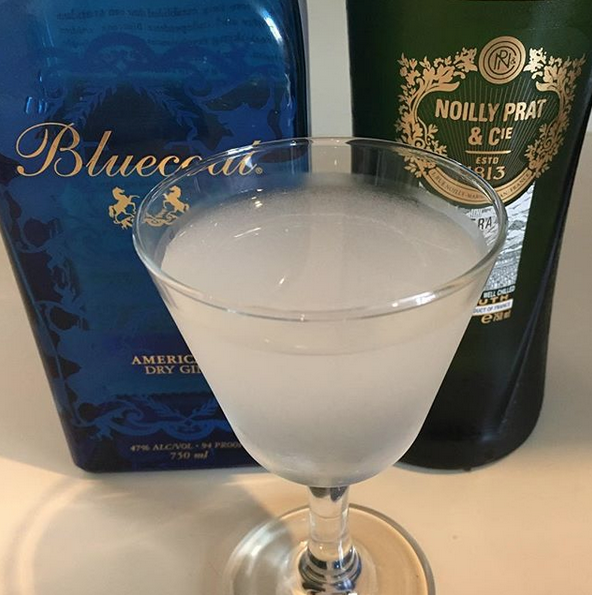
218. Mah-Jongg Cocktail

My interpretation:
  1 oz Cointreau
  1 oz Bluecoat American Dry Gin
  0.5 oz Bacardì Superior White Rum

Shake well (20 seconds), strain into cocktail glass, serve. — This exotically titled recipe appears first in the Savoy Cocktail Book (1935) and from thence is borrowed only for JM1933, the fifth and final edition. In the process, the ratio is changed, since Savoy indicates a 4:1:1 ratio of Gin to Cointreau and Rum (probably conceived as 2/3 Gin and 1/3 Cointreau-Rum mix); Jack’s ratio is 2:2:1, significantly upping the Cointreau quotient and reducing the rum to a background accent by comparison. Using white rum, this drink affords a pearly white quality when shaken, here enhanced by the iridescent effect of Roman glass.
 

Wednesday, October 24, 2018

211. Little Devil Cocktail

My interpretation:
  1 oz Bluecoat Gin
  0.75 oz Cointreau
  0.25 oz Myers’s Rum
  1 T fresh lemon juice

Shake well (30 seconds), strain into cocktail glass, serve. — This recipe, which resembles a sort of Gin-based riff on Between the Sheets (No. 32), appears first in McElhone’s Barflies and Cocktails (1927) where it is attributed to the author’s pupil, Fitz, of Ciro’s bar, London. Apparently Jack thought it worth including; as a gin-based punch-style recipe, it may have been enjoying great enough success overseas.


Monday, October 15, 2018

202. Knickerbocker Special Cocktail

 My interpretation:
  1.5 oz Appleton Estate
  0.5 oz Pierre Ferrand Dry Curaçao
  1 tsp homemade raspberry syrup
  1 tsp fresh lemon juice
  1 tsp fresh orange juice
  1/4 slice pineapple (peeled, for mixer)

Shake ingredients together with ice, including quarter pineapple slice. Strain into cocktail glass, garnish with fresh pineapple, serve. — Although a Knickerbocker Special (not a Cocktail) was included from the first JM 1908, which called for similar ingredients (with St. Croix rum) to be poured in a glass with cracked ice and dressed “with fruits in season,” the present recipe, which is a variation thereof, appears in The Savoy Cocktail Book (1930), where the instructions are absent. It seems that it was borrowed thence on the assumption that a smaller, iceless recipe was meant. The Waldorf-Astoria Bar Book, in its chapter on punches, further specifies a claret float. At any rate, a “cocktail” in this period would suggest a strained drink served in a cocktail glass (with or without bitters), making this an adaptation of the original Knickerbocker Special (Punch), which would accordingly be served in a punch glass. That recipe appears elsewhere in Jack’s Manual.


Saturday, August 11, 2018

138. Fluffy Ruffles Cocktail


My interpretation:
  1 oz Bacardi White
  1 oz Cocchi Vermouth di Torino

Shake well (30 seconds) with ice, strain into cocktail glass, express lime (or lemon) peel over glass, and garnish. — I prefer the lime with the rum. I use Cocchi to add a little bitterness which is otherwise lacking in this Duo. The recipe previously appeared in the 1930 Savoy Cocktail Book.
 

Sunday, July 15, 2018

111. Daiquiri Cocktail


My interpretation:
  2 oz El Dorado or Bacardi Rum (white)
  1 T lemon or lime juice
  1 tsp powdered sugar

Shake well (20 seconds), strain into cocktail glass. — The standard version of this rum sour today calls for lime, but lemon is a good alternative. Lemon-lime (1 tsp. each) is another good choice.


Wednesday, May 30, 2018

66. B. V. D. Cocktail


My interpretation:
  0.33 oz Bacardí 8 (1/3 pony)
  1.66 oz Bombay Sapphire
  1 oz  Gallo Extra Dry

Shake well (20 seconds) with ice, strain into cocktail glass. — This classic cocktail, not appearing in previous editions of JM, was added to the Post-Prohibition 1933 edition from an unknown source, perhaps with intentional adjustment of the proportions. It calls for a gin-heavy drink light on the rum, where other recipes often call for equal parts. A cynic might call it a “Dry Martini with a dash of rum.”
 

Thursday, April 19, 2018

19. Bacardi Cocktail


My interpretation:
  1.25 oz Bacardí 8 Años
  0.25 oz Demarara 3 Year
  0.75 oz Casa Mariol Vermut Negro
  0.75 oz Martini & Rossi Extra Dry

Fill mixing glass with broken ice, stir mixture, strain, serve. I wanted to use the Bacardí 8 here but it needed to be balanced a little with some 3 Year Demarara. I much prefer this version of a “Bacardi Cocktail” (what we might call a Bacardi Perfect) as a vehicle for the rum to the usual version with grenadine and lime juice (as e.g. found in Straub 1914).


Friday, April 13, 2018

13. Apple-Pie Cocktail


My interpretation:
  1.5 oz Bacardí 8
  1.5 oz Casa Mariol Vermut Negro
  4 dashes (one barspoon) Hiram Walker Apricot Brandy
  2 dashes Rose’s Grenadine
  2 barspoons lime (not pictured)

Shake well (on broken ice), strain, serve. It doesn’t taste like apple-pie (you can find lots of recipes that do that these days), and I’m not sure if it was meant to, but the specific brand of apricot liqueur might have something to do with it. A nice Abrikos would improve it, as would a better (i.e., not a last-minute purchase) grenadine, like Liber & Co.—which I used up at a party making Applejack Specials—or Jack Rudy.


Turning the Page

Greetings! We have come to the end of the Cocktails section from Jack’s Manual (1933). In the process of our study, we have discovered so...