An amateur mixologist prepares and assesses the cocktails and miscellaneous drink recipes in Jack Grohusko's mixed drinks manual.
Tuesday, July 17, 2018
113. Delmonico Cocktail
My interpretation:
1.5 oz Hawthorn’s London Dry Gin
1.5 oz Noilly Prat or Martini & Rossi Dry Vermouth
Shake, strain, serve in cocktail glass, garnish with orange peel. — This recipe seems to come from Straub 1913. The standard cocktail by this name currently contains a portion of Cognac or Brandy in addition to Gin and Dry Vermouth. The Old Waldorf-Astoria Bar Book (1935) has two orange peels and adds a dash of Orange Bitters but no brandy. Here are two presentations of this recipe:
Monday, July 16, 2018
112. Dean Cocktail
My interpretation:
1 oz Bulleit Rye
1 oz Cocchi Vermouth di Torino
1 dash Amaro CioCiaro
1 dash Luxardo maraschino
Fill mixing-glass with ice, stir, strain into cocktail glass, serve. — A good Manhattan riff, similar to the Brooklyn with its bitter orange quality, dating back to the first JM 1908.
Sunday, July 15, 2018
111. Daiquiri Cocktail
My interpretation:
2 oz El Dorado or Bacardi Rum (white)
1 T lemon or lime juice
1 tsp powdered sugar
Shake well (20 seconds), strain into cocktail glass. — The standard version of this rum sour today calls for lime, but lemon is a good alternative. Lemon-lime (1 tsp. each) is another good choice.
Saturday, July 14, 2018
110.5* Excursus on Martini-Style Cocktails in JM
Excursus on Martini-Style cocktails in Jack’s Manual.
Nowadays “Martini” describes any proportion of gin and dry vermouth chilled and diluted by mixture with ice. The number of barely distinguishable cocktails containing gin and vermouth and bearing different names in the early twentieth century may explained by the variety of sources and experience from which Jack’s Manual draws. Additionally, Hotel, club, and bar “house” cocktails were often nothing more than their own version of a gin-and-vermouth or whisky-and-vermouth mixture. Jack Grohusko sometimes allows the same recipe to appear with two different names, but in general he seems to preserve a distinction in each one. Here is list to help clarify (to keep it simple, I omit those that have a dash of something — like the Martini, a 1:1 stirred with sweet vermouth, which adds Orange Bitters).
Gin + Dry Vermouth
3:1 stirred w/ orange peel = Treasurer
3:1 shaken = Cushman
w/ lemon peel = Blackstone No. 1
w/ orange peel = Blackstone No. 2
3:2 stirred = Duke.
3:2 shaken = Coney (post-1910)
1:1 stirred = Dry Martini
w/ olive = Cat
w/ orange peel = Racquet Club
1:1 shaken = Cornell, Lewis, Coney (1908–10)
w/ pimola = St. Francis
"Martinez" - Gin + Sweet Vermouth
4:1 shaken w/ orange peel, served down = Parson
3:1 shaken = Consolidated.
3:2 stirred w/ orange peel = Rossington (w/ Old Tom gin before 1933)
1:1 stirred = Perfect or Turf Club (not the Turf)
"Perfect Martini" - Gin +Dry Vermouth + Sweet Vermouth
16:3:1 (80%, 15%, 3%) shaken, served down = Shonnard
3:1:1 w/ lemon peel = Sphinx
2:1:1 = Four Dollar
w/ orange peel = Blackstone or McLane
w/ orange peel served down = Boles
Nowadays “Martini” describes any proportion of gin and dry vermouth chilled and diluted by mixture with ice. The number of barely distinguishable cocktails containing gin and vermouth and bearing different names in the early twentieth century may explained by the variety of sources and experience from which Jack’s Manual draws. Additionally, Hotel, club, and bar “house” cocktails were often nothing more than their own version of a gin-and-vermouth or whisky-and-vermouth mixture. Jack Grohusko sometimes allows the same recipe to appear with two different names, but in general he seems to preserve a distinction in each one. Here is list to help clarify (to keep it simple, I omit those that have a dash of something — like the Martini, a 1:1 stirred with sweet vermouth, which adds Orange Bitters).
Gin + Dry Vermouth
3:1 stirred w/ orange peel = Treasurer
3:1 shaken = Cushman
w/ lemon peel = Blackstone No. 1
w/ orange peel = Blackstone No. 2
3:2 stirred = Duke.
3:2 shaken = Coney (post-1910)
1:1 stirred = Dry Martini
w/ olive = Cat
w/ orange peel = Racquet Club
1:1 shaken = Cornell, Lewis, Coney (1908–10)
w/ pimola = St. Francis
"Martinez" - Gin + Sweet Vermouth
4:1 shaken w/ orange peel, served down = Parson
3:1 shaken = Consolidated.
3:2 stirred w/ orange peel = Rossington (w/ Old Tom gin before 1933)
1:1 stirred = Perfect or Turf Club (not the Turf)
"Perfect Martini" - Gin +Dry Vermouth + Sweet Vermouth
16:3:1 (80%, 15%, 3%) shaken, served down = Shonnard
3:1:1 w/ lemon peel = Sphinx
2:1:1 = Four Dollar
w/ orange peel = Blackstone or McLane
w/ orange peel served down = Boles
110. Cushman Cocktail
My interpretation:
1.5 oz Hawthorn’s London Dry Gin
0.5 oz Noilly Prat Extra Dry Vermouth
Fill mixing-glass with ice; shake (about 15 seconds), strain, and serve. — A shaken 3:1 martini riff, this cocktail appears from the beginning in JM 1908, specifying Gordon gin and Chappaz vermouth. In JM 1910 (2nd ed.), with generalized ingredients, it inexplicably appears on p. 35 after Catawba Cooler (it looks like several unalphabetical recipes were wedged in here. Straub picks it up, too, presumably from JM’s 3rd edition, for his own 1913 manual.
Friday, July 13, 2018
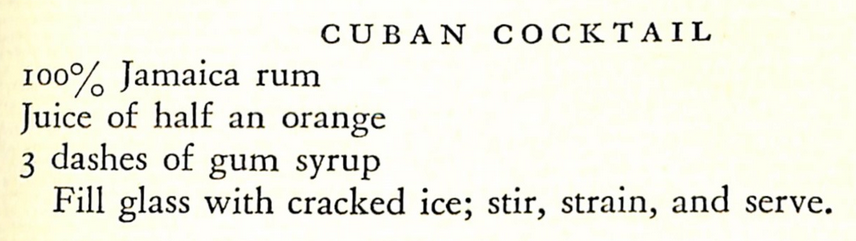
109. Cuban Cocktail
My interpretation:
2 oz Myers’s Jamaican Rum
2 T fresh orange juice
3 dashes homemade gum syrup
Fill mixing-glass with cracked ice; stir, strain, serve. — This cocktail first appears in JM third edition (1910-II) and remains unchanged. It is not to our thinking very Cuban, calling for Jamaican rum and orange juice instead of lime as it does. Straub errs in another way, using lime juice but substituting gin and brandy for rum and apricot brandy for the sweetener. Finally, it is also well to note that Jack’s recipe for “gum” syrup includes no gum arabic and should, for authenticity’s sake, be interpreted as simple syrup (here from the 3rd Edition):
I have, however, taken the opportunity to make my own gum syrup, and used it to great advantage in this cocktail.
Thursday, July 12, 2018
108. Cris Cocktail
My interpretation:
1.25 oz Hawthorn’s London Dry Gin
1.25 oz Martini & Rossi Extra Dry Vermouth
2 dashes Luxardo Maraschino
Fill mixing-glass with broken ice, stir, strain into cocktail glass, and serve. — This counterpart to the Christie, a JM standby from the start, and thus another 50/50 stirred martini riff, has maraschino substituted for the Peychaud’s Bitters.
Wednesday, July 11, 2018
107. Crescent Cocktail
My interpretation:
0.75 oz McKenna 10 Year
0.75 oz Cocchi Vermouth di Torino
0.33 oz Amaro CioCiaro
1 tsp homemade raspberry syrup
Shake well (20-30 seconds), strain into cocktail glass, and serve. — This Manhattan riff takes a cue from Jack’s very own Brooklyn, amps down the main ingredients, amps up the Amer Picon, dropping the bitters and making for a sweeter drink with bitter complexity from the Picon and just a touch of tartness. To augment the bitterness of the CioCiaro I opt for Cocchi amber vermouth.
Tuesday, July 10, 2018
106. Creole Cocktail
My interpretation:
1.25 oz Cocchi Vermouth di Torino
0.75 oz St. George Absinthe
Fill mixing-glass with broken ice, shake 20 seconds, strain into cocktail glass, serve. — This Creole cocktail (duo) derives from Straub’s Chicago recipe and appears in the 1916 and 1933 editions of Jack’s Manual.
1.25 oz Cocchi Vermouth di Torino
0.75 oz St. George Absinthe
Fill mixing-glass with broken ice, shake 20 seconds, strain into cocktail glass, serve. — This Creole cocktail (duo) derives from Straub’s Chicago recipe and appears in the 1916 and 1933 editions of Jack’s Manual.
Monday, July 9, 2018
105. Cotton Cocktail
My interpretation:
1.5 oz Bulleit Rye
0.5 oz Dolin Rouge
0.5 oz Noilly Prat Extra Dry
1 dash St. George Absinthe
2 dashes Regan’s Orange Bitters
Fill mixing-glass with broken ice; stir, strain into cocktail glass, and serve. — This “perfect” Manhattan riff with added dash of absinthe and use of lemon peel, first appears in the Third Edition, JM 1910 (II) and continues to JM 1933.
Sunday, July 8, 2018
104. Coronation Cocktail
My interpretation:
0.75 oz Noilly Prat Extra Dry Vermouth
0.75 oz Hawthorn’s London Dry Gin
0.5 oz Dubonnet
Stir with ice, strain, serve. — This cocktail appears in the 3rd Edition, JM 1910, calling for equal portions and “orange gin” rather than dry gin, as it appears in Straub 1913:
The change in proportions may have been for finer balance of the palate, or perhaps to conserve an increasingly rare Dubonnet. The name and year suggest this was created after the death of Edward VII in preparation for the coronation of George V, but it may have been for Edward VII’s coronation in 1902.
0.75 oz Noilly Prat Extra Dry Vermouth
0.75 oz Hawthorn’s London Dry Gin
0.5 oz Dubonnet
Stir with ice, strain, serve. — This cocktail appears in the 3rd Edition, JM 1910, calling for equal portions and “orange gin” rather than dry gin, as it appears in Straub 1913:
The change in proportions may have been for finer balance of the palate, or perhaps to conserve an increasingly rare Dubonnet. The name and year suggest this was created after the death of Edward VII in preparation for the coronation of George V, but it may have been for Edward VII’s coronation in 1902.
Subscribe to:
Posts (Atom)
Turning the Page
Greetings! We have come to the end of the Cocktails section from Jack’s Manual (1933). In the process of our study, we have discovered so...
-
Greetings! We have come to the end of the Cocktails section from Jack’s Manual (1933). In the process of our study, we have discovered so...
-
My interpretation: 1 oz Plymouth Gin 0.5 oz Martini & Rossi Extra Dry 0.25 oz Rothman & Winter Orchard Apricot 0.25 o...