Friday, August 17, 2018

144. Fowler Cocktail

My interpretation:
  1.5 oz Castle & Key London Dry Gin
  0.5 oz Dolin Dry
  2 barspoons Cocchi Vermouth di Torino
  2 T fresh orange juice

Shake with ice, strain into cocktail glass, and serve. — This recipe, resembling the oldest versions of the Bronx as a martini riff with a small portion of sweet vermouth and orange juice to sweeten and round it out, first appears in JM 1910 (2nd edition) and continues without change to 1933.

Thursday, August 16, 2018

143. Fourth Regiment Cocktail

My interpretation:
  1 oz McKenna 10 Year Bonded Whisky
  1 oz Dolin Rouge
  1 dash Regan’s Orange Bitters
  1 dash Angostura bitters
  1 dash Bitter Truth celery bitters

Shake with ice, strain into cocktail glass, garnish with lemon peel, serve. — This classic Manhattan riff comes to JM 1916 from an unknown source, not appearing in Straub 1913. While it is usually made with Rye these days, I take Jack’s generic whisky as an invitation to defy the trend, and the experiment is successful on the whole, the celery working nicely with the flavors of the bourbon.
 

Wednesday, August 15, 2018

140. Folies Bergère "Cocktail" (= Cooler)


My interpretation:
  2 oz Bacardí Superior
  6 strawberries, washed and hulled
  2 sprigs of mint
  4 T orange juice
  2 T lime juice 
  2 oz soda

Muddle strawberries and mint sprigs with the rum, add orange and lime juice, stir, pour into highball or shaker filled with ice, top up with soda, add straw and fresh mint leaves or lime garnish. — Of the three recipes attributed to the old Parisian club first appearing in the later JM 1910 (third) edition, viz.


JM 1933 keeps not the cocktail but the Cooler for the cocktail section. Nevertheless, here it is. Perhaps I will add the cocktail as No. 140 1/2 at some point in the future.


Tuesday, August 14, 2018

142. Fourth Degree Cocktail

My interpretation:
  0.75 oz Copper & King’s Absinthe Blanche
  0.75 oz Martini & Rossi Extra Dry
  0.75 oz Cocchi Vermouth di Torino

Shake with ice about 30 seconds, double strain into cocktail glass, serve. — This recipe comes to JM 1916 from Straub 1913. The Savoy Cocktail Book recipe has equal parts dry vermouth, sweet vermouth, and gin, with only 2 dashes of absinthe. This seems more accessible. Nevertheless, the present recipe is itself more accessible than the Duchess above, the only difference being the specified absinthe. In the Duchess, I used St. George Absinthe Verte. Here, since it called for white, I used the Copper & King’s absinthe alembic blanche, which is noticeably smoother and harmonizes better with the vermouths.
 

Monday, August 13, 2018

141. Four-Dollar Cocktail


My interpretation:
  1 oz Gin Lane 1751 London Dry
  0.5 oz Dolin Dry
  0.5 oz Cocchi Vermouth di Torino

Stir in mixing-glass half-full of ice, strain into cocktail glass, serve. — This recipe, first appearing in laconic Straub 1913 (we have added the instruction to stir with ice) and borrowed for JM 1916, is the definition of a Perfect Martini, that is, a Martini with equal parts of sweet and dry vermouth. The name is humorous. At the time of Straub, a cocktail was about 20 cents, in 1933 about 30 on average. In today’s dollars, that would make this a Hundred Dollar, or Two Hundred Dollar, cocktail; perhaps Double Benjamin rolls of the tongue better?

Sunday, August 12, 2018

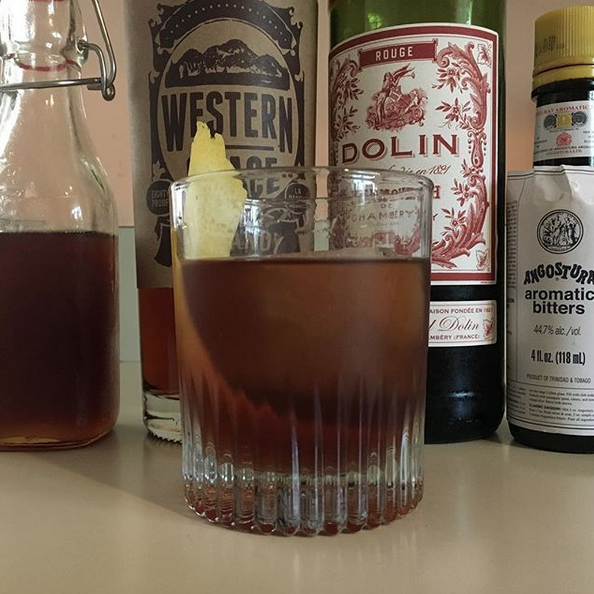
139. Flushing Cocktail


My Interpretation:
  1.5 oz Western Grace brandy
  1 oz Dolin Rouge
  1 dash homemade gum syrup
  1 dash Angostura bitters
  1 lemon peel

Stir with cracked ice, strain into Old Fashioned glass with large ice, express lemon peel and garnish. — A sweetened brandy Manhattan served down, this recipe appears first in Straub 1913 with a 2:1 ratio of brandy to vermouth. For his 1916 edition, Jack adjusts the ratio to 3:2.

Saturday, August 11, 2018

138. Fluffy Ruffles Cocktail


My interpretation:
  1 oz Bacardi White
  1 oz Cocchi Vermouth di Torino

Shake well (30 seconds) with ice, strain into cocktail glass, express lime (or lemon) peel over glass, and garnish. — I prefer the lime with the rum. I use Cocchi to add a little bitterness which is otherwise lacking in this Duo. The recipe previously appeared in the 1930 Savoy Cocktail Book.
 

Friday, August 10, 2018

137. Five Fifteen Cocktail


My interpretation:
  1 oz Dolin Dry
  0.75 oz Pierre Ferrand Dry Curaçao
  0.25 oz heavy cream

Shake well (30 seconds) with ice, strain into cocktail glass, serve. — This lighter after-dinner cocktail first appears in JM 1933 from an unknown source.


Thursday, August 9, 2018

136. Fine and Dandy Cocktail


My interpretation:
  1 oz Gin Lane 1751 London Dry
  1 oz Cointreau
  1 dash Angostura bitters
  1 T lemon juice.

Shake well (30 seconds) with ice, strain into cocktail glass, serve. — This cocktail, new to JM 1933, previously appears in the Savoy Cocktail book 1930. It is essentially a White Lady with addition of bitters.
 

Wednesday, August 8, 2018

135. Fifth Avenue Cocktail

 My interpretation:
  0.5 oz Hiram Walker Crème de Cacao
  0.5 oz Rothman & Winter Apricot Liqueur
  0.25 oz heavy cream

Pour ingredients carefully in order over the back of a spoon. — This recipe first appears in 1933, following the recipe described in the 1930 Savoy Cocktail Book.


Tuesday, August 7, 2018

134. Favorite Cocktail


My interpretation:
  3 sprigs of mint
  2 oz Gin Lane 1751 London Dry
  5 oz Hansen’s Ginger Ale
  2 T fresh lime juice

Muddle mint with gin and lime juice in bottom of highball glass. Add 2–3 large ice cubes and fill with ginger ale. Serve with straw. — This recipe, a sort of Cooler or minted Buck resembling a larger version of the Clarendon “Cocktail” above, first appears in JM 1916 from an unknown source, though similar to a number of variously named long drinks of the type which continues to be popular with other, especially exotic, base liquors. It is clearly unrelated to the Favourite in the Savoy Cocktail Book. The specification of “imported” ginger ale is curious, and may indicate the spicier ginger beer of, e.g., British, Australian, or Jamaican origin.
 

Turning the Page

Greetings! We have come to the end of the Cocktails section from Jack’s Manual (1933). In the process of our study, we have discovered so...