Tuesday, March 26, 2019

365. Waldorf Special Cocktail.

 My interpretation:
  2 oz Rothman & Winter Orchard Apricot
  1 T lime juice

Shake well (30 seconds), strain into cocktail glass, serve. — This recipe, if it may be called that (better, an apricot liqueur treatment neatly balanced with a little lime), which makes a nice post-prandial, is first described in Straub 1913 (specifying “apricotine”) before appearing in JM 1916. It does not appear in the Old Waldorf Bar Days book—which doesn’t mean, of course, that it was not served or invented there. When combined with a dry martini, it becomes a Webster (q.v.)


Monday, March 25, 2019

364. Waldorf Cocktail

My interpretation:
  1 oz Castle & Key London dry gin
  1 oz Kronan Swedish punsch
  1 tsp lemon juice
  1 tsp lime juice

Fill mixing-glass with ice, shake well (30-40 seconds), strain into cocktail glass, serve. —This Gin-Swedish Punsch Sour is one of several Waldorf cocktails preserved by Grohusko in JM 1916 and 1933 after Straub’s inclusion of them in 1913/1914. The same recipe appears in the Savoy Cocktail Book (1930). Curiously it does not appear in the Old Waldorf Bar Book (at least in the cocktail section).


Sunday, March 24, 2019

363. Virgin Cocktail

My interpretation:
  1 oz Plymouth Gin
  1 oz Martini & Rossi sweet vermouth
  3 dashes Angostura bitters
  2 dashes homemade raspberry syrup

Fill mixing-glass half full of ice, stir well (30 seconds), strain into cocktail glass, serve. — This martini + raspberry and angostura first appears in JM 1908 specifying Plymouth gin. The specification falls away by 1933. A different recipe by the same name appears in Barflies & Cocktails (1927) calling for Forbidden Fruit liqueur, creme de menthe, and gin, which is also in the Savoy Cocktail Book (1930). This book has also has a Virgin Special, a large-format drink with raspberry, gooseberry, redcurrant, brandy, gin, and fruit.


Saturday, March 23, 2019

362. Vienna Cocktail

My interpretation:
  1 oz Martini & Rossi Rosso (sweet vermouth)
  1 oz Noilly Prat extra dry vermouth
  1 dash St. George absinthe verte

Fill mixing-glass with fine ice, frappé (shake vigorously), strain into cocktail glass, serve. — This vermouth x2 duo + absinthe first appears in Straub 1913. A light drink that can be enjoyed anytime, it can easily be imagined being deposited on a small café table in Vienna, Austria or Vienna, Virginia.


Friday, March 22, 2019

361. Vermouth Cocktail

2 oz Martini & Rossi sweet vermouth
1 dash Fee Brother’s cardamom bitters
1 dash Luxardo maraschino

Fill mixing-glass with fine ice, frappé (shake well), strain into cocktail, serve. — This recipe appears in JM 1908 following the Vermouth Frappé, the distinction apparently confined to the addition here of maraschino. Boker’s bitters is best replicated by Dr. Elmegirab’s Boker’s bitters, but any aromatic bitters will do adequately here if the vermouth has a harmonious character. The Savoy Cocktail Book (1930) gives the option sweet or dry vermouth, and of 4 dashes orange bitters or 1 dash Angostura, but no maraschino; the drink is stirred rather than shaken. The Old Waldorf Bar Book (1931) lists the French and Italian Vermouth Cocktails separately, calling for one dash of orange bitters for each.


Thursday, March 21, 2019

360. Van Zandt Cocktail

My interpretation:
  1 oz Castle & Key London dry gin
  1 oz Martini & Rossi extra dry vermouth
  1 dash Rothman & Winter apricot liqueur

Fill mixing-glass with ice, shake, strain into cocktail glass, serve. — This martini + apricot first appears in JM 1908 as a shaken drink, but is reproduced in Straub as a stirred one. Apparently a man named Van Zandt ordered them frequently enough to get them included in Grohusko’s repertoire. It is absent from other cocktail books.
  

Wednesday, March 20, 2019

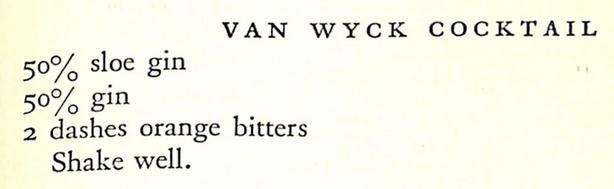
359. Van Wyck Cocktail

My interpretation:
  1 oz Castle & Key London dry gin
  1 oz Plymouth Sloe Gin
  2 dashes Regan’s Orange Bitters

Shake well with ice, strain into cocktail glass, serve. — This frothy yin-yang Duo of strong and syrupy hanging in dubious balance, strapped together with a cord of faint but deep orange bitters, first appears in Straub 1913 with “dry gin.” In JM 1916 it becomes the second of three “Vans” in the cocktail section of Grohusko’s, also specifying dry gin. This agreement suggests the Waldorf Bar as the common source, which is tentatively confirmed by reference to the Old Waldorf Bar Book (1931), where the drink appears with Old Tom gin and sloe gin in a 2:1 ratio, with the orange bitters, stirred, with “fruit in glass.” It was apparently to be drunk in the Van Wyck tunnel.


Tuesday, March 19, 2019

358. Van Lee Cocktail

My interpretation:
  1 oz Castle & Key London dry gin
  0.75 oz Dubonnet Rouge
  0.25 oz The Famous Grouse scotch whisky

Fill mixing-glass with broken ice, stir, strain into a cocktail glass, serve. — This variant on an Apéritif Cocktail (be it Byrrh, Saint Raphael, or Dubonnet), spiced up with a notion of Scotch whisky, first appears in JM1910 with Byrrh instead of Dubonnet, as usual in the earlier books. It is not picked up by Straub, and appears to be named for one of the local fixtures at Jack’s bar.


Monday, March 18, 2019

357. Union League Cocktail


My interpretation:
  1.25 oz Gin Lane 1751 Old Tom
  0.75 oz Offley Tawny Port
  1 dash Fee Brothers Orange Bitters

Fill mixing-glass half full with ice, stir well (about 30 seconds), strain into cocktail glass, serve. — The Union League comes to JM1916 from Straub 1913/1914, where it has the slightly stronger ratio of 2:1 rather than 3:2. It is named for one of the famous conservative clubs, perhaps that in New York on Union Square, which has since moved; though since this recipe is found first in Straub, who spent time in Chicago, that Union Club may be the originator. Its similarity to Kappeler’s Princeton Cocktail is notable (Jack’s is a Gin Cocktail topped with Seltzer), except that he layers in the port neatly instead of stirring it in. The Union League is all but forgotten as such (a brand new, impostor “Union League” with whisky and orange juice is now being promoted), with the Princeton slightly more common. The most famous Gin+Port drink at present seems to be the more citrusy Crimson.


Sunday, March 17, 2019

356. U. C. Cocktail

My interpretation:
  1 oz Castle & Key London Dry Gin
  1 oz Martini & Rossi Extra Dry Vermouth
  1 dash St. George absinthe verte

Fill shaker with ice, shake about 30 strokes, strain into cocktail glass, serve. — This shaken Martini+absinthe recipe first appears in Straub 1913 without a hint as to the source of the name.
 

Saturday, March 16, 2019

355. Two-Spot Cocktail

My interpretation:
  1 oz Pierre Ferrand Dry Curaçao (uncolored)
  1 oz Martell VS Cognac

Fill shaker with ice, shake, strain into cocktail glass, twist lemon peel, garnish, serve. — This Straub 1913 Duo with the unusual call for Curaçao Brun (not readily available here) has been modified in my preparation by the use of a Curaçao which necessarily presents a different flavor profile as well as color. In any event, the drink appears to be a local phenomenon in Straub and Grohusko which did not afterward gain traction.
 

Turning the Page

Greetings! We have come to the end of the Cocktails section from Jack’s Manual (1933). In the process of our study, we have discovered so...